
SEBI’s heart in the right place with move to widen ESG disclosure requirements



WHAT IS XBRL
WHAT IS XBRL?
XBRL is an open standard for the electronic communication of business and financial data. XBRL is essentially a dictionary of “tags” that can be applied to each element in a financial statement. This tells standard software what the item represents and how it relates to other items in the report, much like giving all the facts in the report a unique barcode.
In XBRL a number isn’t simply say 1,000,000. In XBRL data the same number is understood as INR 1,000,000 is the sales of Company ‘X’ for the Indian segment of particular products for a particular quarter for a particular year. In other words descriptive items such as the currency, time period etc. become a part and parcel of the number itself. This approach allows users to compare the tags of one company between periods or even to compare the tags between companies.
For example, users will know that when they are comparing the revenue tags between Company A and Company B that they are in fact comparing data in the same currency and across the same period. The benefits to management and investors are obvious, as they can now get information very quickly and in a context that is clearly defined by the tag.
WHY XBRL?
The advantages of XBRL data over conventional forms of data are given below

STANDARD
XBRL is a standard that has been accepted and adopted the world over thus reducing inconsistencies in terminologies and data formatting.

ACCURACY
XBRL provides highly accurate data as the data can be both calculated and verified.

SPEED
XBRL allows much faster and real-time preparation of reports and at the same time allows efficient, accurate and relevant ways to search data

REUSABLE
XBRL data once entered can be reused to represent the same data in multiple ways and multiple formats.

PLATFORM INDEPENDENT
XBRL is an open standard and hence platform independent, this allows the data to be exchanged and transferred with ease.

REGION INDEPENDENT
XBRL allows the presentation and exchange of data in many different languages.
HOW DOES XBRL WORK?
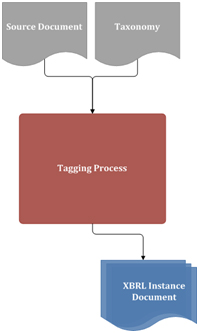
An XBRL document can be viewed as a system of barcodes. These barcodes not only contain the information but also attributes that describe the information. The XBRL process can be understood better with the help of the diagram to the left:
The source document is the annual report of the company that is to be converted to XBRL.
The taxonomy of XBRL is in literal terms a dictionary of elements that are reported. The taxonomy provides the tags (barcodes) for all the elements appearing in the annual report.
The creation of XBRL documents involves the process of tagging the document. Tagging is the process of assigning barcodes to all the elements appearing in the annual report.
Once all the elements appearing in the annual report have been tagged the XBRL Instance document is generated and the process is complete.
The XBRL instance document contains all the facts that are reported in the annual report along with the descriptive attributes about the data that is reported. The instance document is platform independent and can be reused to represent and transfer data as per the requirements of the user.